

News Center
Create an intelligent pipeline
How much do you know about the shock absorption principle of Double Flanged Limited Expansion Joint
Release time:
2021-09-15
First of all, in terms of its own structure, Double Flanged Limited Expansion Joint is composed of inner and outer layers of rubber, a middle stress skeleton house, and two-end steel rings, and is equipped with a standard half, which has high pressure resistance, vibration resistance and noise reduction, and displacement compensation.
With the development of modern technology and industry, noise pollution has become a worldwide problem, and sound absorption and noise reduction have gradually evolved into an important issue related to technology, the environment, the coordinated development of human beings, and even the modern military. Therefore, in the application of pipelines Double Flanged Limited Expansion Joint is becoming more and more important to our development. So, how much do you know about the shock absorption principle of Double Flanged Limited Expansion Joint?
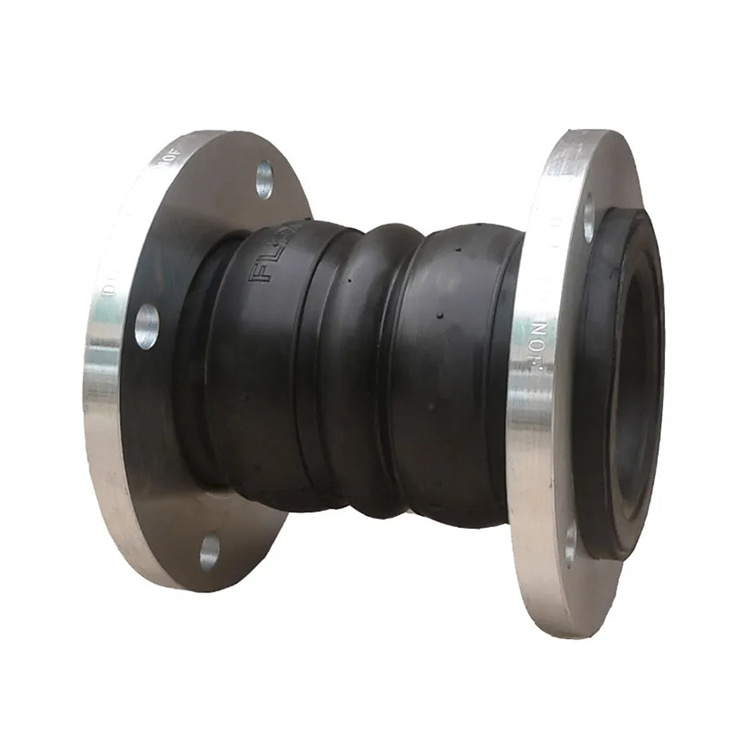
First of all, in terms of its own structure, Double Flanged Limited Expansion Joint is composed of inner and outer layers of rubber, a middle stress skeleton house, and two-end steel rings, and is equipped with a standard half, which has high pressure resistance, vibration resistance and noise reduction, and displacement compensation. It has the characteristics of obvious effect, and can play the role of vibration isolation, noise isolation and displacement compensation. This product is mainly used in various pipeline systems such as water supply and drainage, compressors, ships, locomotives, etc. Rubber joint products are manufactured for the connection of pipelines and the protection of pump and valve products. Rubber products have the characteristics of thermal expansion and contraction. There are also different reflections. When axial compression or expansion occurs, the sphere itself can protect the vibration or deflection of the pipeline within the allowable expansion and contraction range, and will not cause the pipeline to break or stop. When the anti-pull device is installed in a special working environment, it can play a better effect.
Thirdly, from the perspective of the rubber material itself, we all know that rubber is a viscoelastic polymer material with relatively large internal friction, and the relative molecular mass distribution of the base rubber is adjustable, which can adapt to the absorption of sound waves of various frequencies. Rubber materials have certain physical properties and can be used in different environmental conditions. The sound absorption rate of the rubber material has a great relationship with the frequency of the sound wave. The general rule is: with the increase of the sound wave frequency of the medium through which the rubber joint passes, the sound absorption rate of the rubber material increases. When the sound wave frequency reaches a certain critical value , the sound absorption rate of the rubber material has a maximum value, and then as the frequency of the sound wave continues to increase, the sound absorption rate of the rubber material decreases instead. Since most SR (such as IIR, NBR, CIIR and SBR, etc.) have a larger temperature coefficient of elastic modulus than NR, the internal friction is large, it is easy to generate heat, and it is more conducive to absorbing sound wave energy, so the sound absorption performance of SR rubber is higher than that of NR rubber. Good material.
The Double Flanged Limited Expansion Joint rubber material has a large internal friction, and a large part is caused by the microstructure of the base rubber. For example, there are many methyl groups in IIR, and the molecules are densely packed, making it relatively difficult for these segments to move, and the internal friction is relatively high. big. The presence of cyano groups, chlorine atoms, and phenyl groups has a similar effect.
In addition, the Double Flanged Limited Expansion Joint also has the ability to resist resistance. Of course, only when the characteristic impedance of the two media is the same or close, the sound waves generated by the media will not be reflected at the interface of the two media. The characteristic impedance of rubber materials is close to that of water, and can be adjusted by changing fillers and other components, which is an important reason why rubber materials are often used as hydroacoustic materials. However, in general, the propagation speed of the sound wave passing through the medium in the rubber material varies with the shape of the rubber material. .
If a carbon black compounding agent, which has a great influence on the modulus, is added to the Double Flanged Limited Expansion Joint rubber material, the propagation speed of the sound wave passing through the medium will increase in the rubber material; if a softener or plasticizer is added Compounding agents, the propagation speed will be reduced.
The propagation velocity of the medium in the rubber material with higher hardness can reach 1560-1573 m·s-1. In addition, the propagation velocity of the sound wave passing through the medium in the Double Flanged Limited Expansion Joint rubber material decreases with the increase of temperature, and the material elongation also has a great influence on the propagation velocity of the sound wave, but the trend is uncertain. Also, the propagation speed of the material also has a certain influence on the sound absorption properties of the material.
Related news

undefined
Mobile Website
Hebei Keweite Pipeline Equipment Co., Ltd.
Tel: +8618332535575
Mail:zfmn1234@gmail.com
Address: Meidel Industrial Park, Chengxi Development Zone, Jingxian County, Hengshui City, Hebei Province
Copyright © 2022 Hebei Keweit Pipeline Equipment Co., Ltd.